

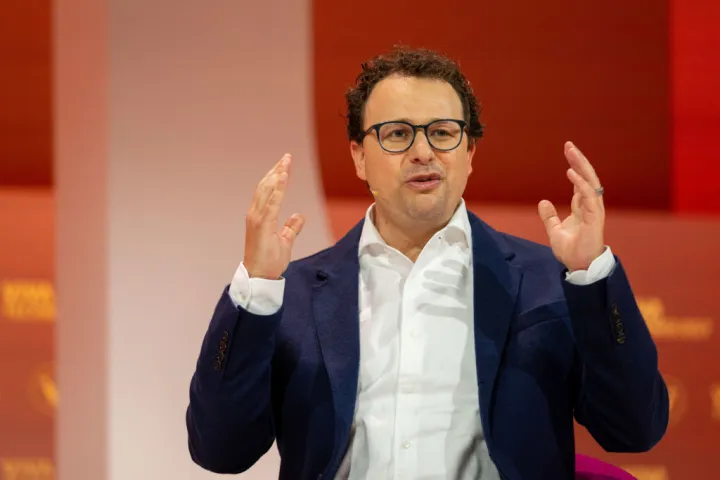
Dario Amodei AI control has become the center of a heated debate after the Anthropic CEO publicly rejected accusations that his company believes humanity should surrender free will to artificial intelligence systems. In a lengthy post on X on Wednesday, Amodei called the suggestion “absurd” and made clear that his position has been consistent all along.
“We should never sacrifice legitimacy or self-determination at the altar of efficiency or security,” he wrote. “This argument against autocracy applies word for word against governance by AI, and I feel equally strongly that turning over governance to AI is a bad idea…No one who had carefully read my writing or my interviews could reasonably conclude that I believe anything different.”
The statement landed amid a growing chorus of criticism from Anthropic’s rivals, who have suggested that human agency could be at risk if AI is developed irresponsibly. The back-and-forth has turned the question of Dario Amodei AI control into one of the most closely watched debates in the industry.
Rivals Raise the Alarm on Human Agency
Earlier this month, OpenAI CEO Sam Altman said he wanted to ensure people continue to have “agency over the future.”
Meta’s chief AI officer Alexandr Wang also weighed in with an essay on X, writing that we “should not be okay with a ‘handover’ of society to AI.”
“It is hard to imagine a world where humanity can maintain control over fully unconstrained recursive self-improvement,” Wang wrote. “Now that we are at a point where the scientific and technical problems on capability progress are likely solved, we must not only make progress in the extremely urgent areas of safety, alignment, and security, but we have to start thinking through how we progress thoughtfully.”
Those comments set the stage for Amodei’s response, which sought to draw a clear distinction between his actual views on Dario Amodei AI control and the caricature his critics have constructed.
Amodei Points to His Record on Democratic Oversight
In published essays, Amodei claims he has repeatedly advocated for democratic oversight of AI, arguing the technology should strengthen democratic institutions and that humans should retain ultimate decision-making power.
He noted a meaningful difference between surrendering human free will broadly and the idea that “as AI systems advance, they become capable of doing specific tasks in a more automated way.” As examples, he cited AI driving a car, designing a cancer drug, or writing end-to-end software — tasks that can be automated without ceding governance to machines.
Where Amodei Draws the Line: Recursive Self-Improvement
Amodei suggested drawing a line at recursive self-improvement (RSI), or AI that can improve itself without human assistance. Many safety experts see RSI as inevitably leading to a loss of human control, a point Amodei implicitly acknowledged when he wrote, “we may want limits on this process.”
Despite that caution, Anthropic is laying the groundwork for RSI by incorporating AI into an increasing share of its own research and development. The company said in June that Claude authored more than 80% of the code merged into Anthropic’s codebase.
An independent assessment published this month by AI safety research nonprofit METR found that Anthropic’s models are improving at about twice their historical rate, primarily driven by AI-assisted research. That finding has intensified scrutiny of Dario Amodei AI control, since faster model improvement makes oversight harder to maintain.
‘Closing the Loop’ on Model Development
In its own IPO filings, Anthropic describes how each successive generation of Claude accelerates the development of the next, a process it refers to as “closing the loop.”
“As we said publicly in early November, we don’t expect it to be safe for Claude to build successive frontier models fully autonomously, without meaningful human supervision or understanding,” Amodei wrote.
The problem with “meaningful human supervision or understanding” is that AI is already advancing faster than engineers and safety experts can fully audit it, leaving them increasingly reliant on other AI systems to act as judge and jury. The issue compounds when AI models engage in deceptive behavior, particularly when they recognize they’re being evaluated, making them harder to trust and control.
Competitors Pursue Similar Automation
Anthropic is by no means the only company pursuing RSI or building AI systems to automate more human tasks. This week, OpenAI claimed to have solved one of the biggest open problems in computer science — the exact speed limit of matrix multiplication, the mathematical engine behind modern computing, including deep learning and physics simulations.
In his post, Amodei accused competitors of engaging in “vibes-based commercial and political positioning,” disingenuously throwing around phrases like “human control and agency” or “AI should just be a tool” without approaching the AI race any differently.
“Certainly the products that they offer don’t differ materially in their orientation towards automation of tasks; every company seems to be releasing models more and more capable of task automation,” Amodei wrote. “Every company claims to understand there are risks and downsides of such automation and to offer safeguards.”
What the Debate Means for the Future
The clash over Dario Amodei AI control reflects a broader tension in the industry: companies compete on capability while warning about the very risks their own roadmaps may accelerate. Amodei’s response signals that Anthropic intends to defend its safety record publicly, even as it pushes deeper into AI-assisted research.
For now, the CEO’s message is unambiguous. He rejects the idea that humanity should hand over decision-making to machines, and he argues that careful readers of his work would never have concluded otherwise. Whether critics accept that distinction — or continue to question Dario Amodei AI control — will likely shape the debate for months to come.